Deep web, dark web and darknet: the differences
Mailbox, network or onion website? Understand the surface web, deep web, dark web, darknets and the imprecise term deepnet.
Explained visually
Three terms, three questions

- Deep web
Which web content is missing from the search index? The messages in your inbox behind a login are one example.
- Darknet
Which special network provides access? Here we use the term for networks requiring a particular way in, such as Tor software.
- Dark web
Which websites are available through those networks? Here this means websites on such networks, including onion websites.
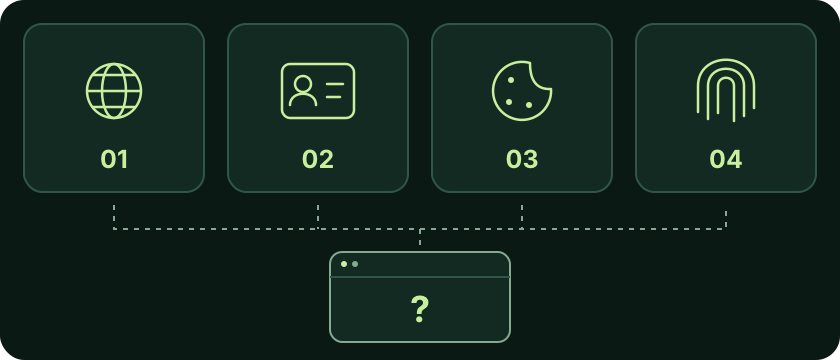
Simplified diagram. Numbers match the elements to their explanations; distances and sizes have no technical meaning.
Your inbox is already an example
You open your email in your usual browser. The sign-in page may appear in a search engine; your private messages behind it should not. Web content that is not indexed is called the deep web. Indexing means adding content to a search catalogue.
Being absent from search results does not protect data, though. A publicly accessible page can also be excluded from results. Someone who knows its address can still open it. Access controls and discoverability are different questions.
Tor is the path; the website is the destination
Tor can refer to a network of volunteer-run relays. Tor Browser uses this network for your connections. An onion website, in turn, is a service reached through Tor.
Tor Browser can also visit ordinary websites. A public weather forecast does not become an onion website just because you read it through Tor.
Three situations to sort out
A private web inbox — Its message area requires a login and is not in the general search index: an example of the deep web. It does not require special access through Tor.
A public recipe page through Tor — You change the path of your connection. The recipe page remains the same ordinary website.
A newspaper with a .onion address — Its onion service requires access through Tor. Whether and where a directory lists the address is another question.
Why no iceberg diagram?
These terms are used inconsistently. Our three cards offer orientation, not three separate floors of the Internet or a measurement of its size. Discoverability, access paths and content can overlap.
An address ending or a search result does not assess the quality of the content either. Check who publishes something and what supports the claim.
What about the surface web and deepnet?
Surface web usually means publicly discoverable web content indexed by search engines. A freely readable news article can belong to it. Not every publicly accessible page is actually indexed.
In conversation, deepnet is sometimes used imprecisely for the deep web or a darknet. We do not treat it as an additional technical layer here. Ask instead: is this about missing search results, a special access route, or a particular website?
Is the dark web a separate internet?
The cables, wireless networks and many devices are the same. A network such as Tor adds another connection path on top. This is called an overlay: a network built over an existing network.
Deep web does not automatically mean illegal or dangerous. Your protected webmail is an everyday counterexample. Equally, inclusion in a search engine does not make a website’s content true or trustworthy. A technical category does not evaluate the service.
Classify three more examples
A club archive behind a login: its private documents belong to the deep web if they are absent from the public search index. The club does not need Tor for this.
A Google-searchable announcement of an onion address: the announcement page can belong to the surface web. The onion service still needs its special access route. Being discoverable and being directly accessible are different properties.
A weather report opened in Tor Browser: the browser changes your path. An ordinary HTTPS address does not become an onion address.
Sources and further reading
Last updated on 2026-10-13
- Tor Project · Introduction to Tor & Onion Services, PDF pp. 35–45 · Accessed 2026-10-02
- Google Search Central · Control what you share with Google · Accessed 2026-10-02
- Tor Project · What is Tor? · Accessed 2026-10-02
- Tor Project · Onion services in Tor Browser · Accessed 2026-10-02
- Tor Project · Onion Services Terminology · Accessed 2026-10-02